


How to Fit Elastic Laces: Step by Step
With elastic laces you slip in and out of your shoes without tying. You lace them once, set the right tension and cut off what is left over. In this guide you will learn step by step how to fit elastic laces with the included no-tie lock. Allow about ten minutes per pair.
What do you need?
- A pair of elastic laces of 120 cm with the included no-tie locks
- A sharp pair of scissors
- Your shoes, with the old laces removed
One length is enough. You cut the lace to size after setting it up, so 120 cm fits almost any sneaker, sports shoe or kids shoe.
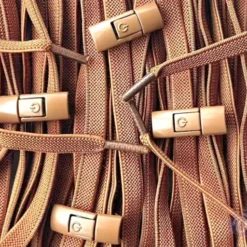
€ 9,95

€ 9,95
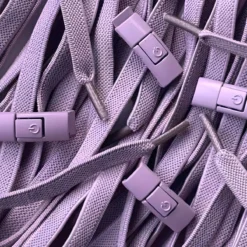
€ 9,95

€ 9,95
How to fit elastic laces in 7 steps
- Take the old laces out of your shoe. Take a quick look at how they were laced if you want to keep that pattern.
- Push the lace through the bottom pair of eyelets from the outside in. Pull it through until both ends are the same length. Keep the band flat, without a twist.
- Lace criss-cross towards the top. Cross the ends over the tongue and push them through the next eyelet from the inside out each time. Keep the flat side facing up.
- Stop at the top pair of eyelets. Both ends come out on the outside there.
- Tighten the lace a little at each crossing until the shoe fits snugly around your foot without pinching. Do this with the shoe on your foot. An elastic lace stretches, so set it slightly tighter than a regular lace.
- Insert each end into the no-tie lock from its own side, so the lock sits across the tongue at the top. Click the lock shut.
- Step in and out a few times. If the tension is right, cut off the excess. Leave a few extra centimetres on each side so you can adjust later.
Then do the same with your other shoe. Put the shoes side by side and check that the locks sit at the same height.
Adjusting the tension
After a few days of wear you will notice whether the tension is right. If your heel slips out of the shoe, the lace is too loose. If you feel pressure on your instep, it is too tight. Open the lock, tighten the lace a little at each crossing or give it some slack and click the lock shut again. That is why you leave a few extra centimetres when cutting.
Troubleshooting
| Problem | Cause | Solution |
|---|---|---|
| Your heel slips out of the shoe | The lace is too loose | Open the lock and tighten the lace a little at each crossing |
| Pressure or pain on the instep | The lace is too tight | Give some slack at each crossing and click the lock shut again |
| The band is twisted | The lace went through an eyelet twisted | Pull that section back and feed it through the eyelet flat |
| One side is much longer | The lace was not centred at the bottom | Slide the lace through the bottom pair until both sides are equal |
| You cut it too short | There is no room left to adjust | Skip the top pair of eyelets or use a new lace |
Frequently asked questions
Does this work with comfort laces?
No. Comfort laces are regular laces with a little stretch. You lace and tie them like any other lace. Our guide how to replace shoelaces shows how. Only elastic laces are truly elastic and work with a no-tie lock.
How much should I leave when cutting the lace?
Leave a few extra centimetres on each side. That way you can adjust the tension later without using a new lace.
Can I use elastic laces in kids shoes?
Yes. You simply cut them shorter. They are handy for children who cannot tie their laces yet.
Do I have to lace criss-cross?
That works best for most shoes, because it spreads the tension evenly over your foot. Straight lacing works too, as long as both ends come out at the top.
Can I reuse the lock?
Yes. You can open the lock to adjust the tension and click it shut again afterwards.
No elastic laces yet? Browse every colour under elastic laces.