

Blogs
How to Hide Shoelaces: 4 Ways to Wear Sneakers Without a Bow
A sneaker without a visible bow looks cleaner. The lines of the shoe stand out more and it is often easier to step into. There are several ways to hide shoelaces, from a bow behind the tongue to laces you never tie at all. In this blog you will find four methods step by step, which lace length goes with them and how to stop a tucked-away knot from pressing.
In short
- The quickest way is the bow behind the tongue: you tie as usual, but on the inside.
- If you want no bow at all, tie a knot in the lace behind the top eyelet on each side.
- Never tuck a knot under the sole of your foot. Behind the tongue or along the side of your foot is where you feel it least.
- Hiding takes less length. It often pays to go one step shorter than with a visible bow.
- Elastic laces with a lock are the answer if you never want to tie again.
How to hide shoelaces: which method suits you?
Which method you choose depends on how snug your shoe needs to be and how often you take it on and off. This overview helps you decide.
| Method | Snug fit? | Step in without undoing? | Suits |
|---|---|---|---|
| Bow behind the tongue | Yes | No | All sneakers |
| Knot behind the top eyelet | Loose | Yes | Low-top sneakers |
| Tucking the ends along your foot | Fairly | Usually | Low-top and high-top sneakers |
| Elastic laces with a lock | Yes | Yes | Sneakers, sports shoes, kids’ shoes |
Method 1: the bow behind the tongue
This is the simplest way and your shoe is as secure as with a visible bow.
- Lace your shoes the way you are used to, but at the top pair of eyelets feed the ends from the outside in.
- Pull the tongue forward and tie the lace on the inside, between the tongue and your instep.
- Press the bow flat and pull the tongue back over it.
Keep the bow small. The flatter the bow, the less you feel it. Flat laces work better here than round ones, because a flat band stacks up less thickly.
Method 2: a knot behind the top eyelet
With this method you stop tying altogether. The lace is held by a knot on each side and you wear the shoe like a slip-on.
- Lace the shoe and put it on. Tighten the lace until the shoe feels comfortable but you can still step in and out.
- Use your fingers to mark where the lace comes out of the top eyelet on each side.
- Take the shoe off and tie a single knot in each end at that point, on the inside.
- Tuck what is left of the ends into the shoe along the side.
The knot cannot slip back through the eyelet, so the lacing stays under tension. This method works best on low-top sneakers that you wear loosely. For sport the shoe is not secure enough this way.


Method 3: tucking the ends along your foot
Here you make no bow and no knot. You lace the shoe, tighten the lace and push both ends down on the inside along the side of your foot. The friction between your foot, the shoe and the lace keeps everything in place.
Lay the ends flat against the side wall and not under your foot. A lace under the sole of your foot can be felt with every step and will eventually wear through the insole. This method is quick, but the tension eases off a little as you walk. So tighten the lace again from time to time.
Method 4: elastic laces with a lock
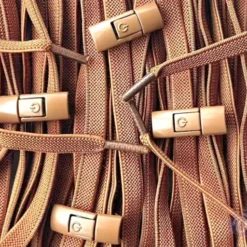
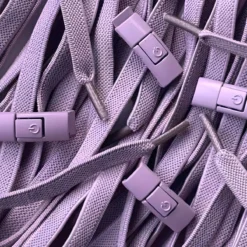
If you want a shoe that fits snugly yet lets you step straight in and out, elastic laces are the best solution. You lace them once, set the tension and click the lock shut. Then you cut the lace to size. There is no bow and there are no loose ends. How to do that is explained in the guide how to fit elastic laces. You can read more about how they work in no tie laces.
Which length do you need when you hide the bow?
Less than with a visible bow. A bow with generous loops easily uses 15 to 20 cm of lace per side. If you hide the bow or work with knots, that length is left over and has to go somewhere inside your shoe. So it often pays to go one step shorter than you normally would. If you normally wear a low-top sneaker with 120 cm, then 100 cm is usually enough when you hide the laces.
If you already have laces that are too long, you will find more fixes in laces too long. Look up the length per number of eyelets in the shoelaces length guide.
Does hiding also work with wide laces and high-tops?
Yes, with one caveat. Wide laces of 20 mm take up a lot of room. A bow behind the tongue soon becomes too bulky. With wide laces the knot behind the top eyelet works better. How to lace wide laces shows you how to keep them nice and flat.
On high-tops you can let the lace end below the top eyelets and tuck it away there. The different ways are covered in how to lace high tops.
Frequently asked questions
Is hiding your laces bad for your shoes?
No, as long as you do not tuck the ends under your foot. If you keep stepping in and out without undoing the shoe, the heel lining does wear out faster.
Can you feel a bow behind the tongue?
With a padded tongue, hardly at all. With a thin tongue a thick knot can press. In that case make the bow smaller or go for the knot behind the eyelet.
Which laces are easiest to hide?
Flat laces of 8 mm. They lie flat against the shoe and make a flat knot. Round and thick laces make a bulky knot that you feel sooner.
Can I hide my laces in sports shoes?
For sport, loose lacing is not a good idea, because your foot will start to slide. Choose elastic laces with a lock instead or tie the lace behind the tongue.
Looking for laces in a shorter length? Browse the basic flat laces or go straight for elastic laces.