

Blogs
Flat, Round or Oval Laces? How to Choose the Right Shape
Shoelaces all look alike until you need to replace them. That is when the shape turns out to matter as much as the length. A wide flat lace looks out of place in a dress shoe and a smooth round cord in a sneaker comes undone more easily. Not sure whether to choose flat, round or oval laces? This guide explains the difference, which shape suits your shoe and how to make sure the new lace fits through your eyelets.
In short
- Flat laces are the standard for sneakers: the bow stays tied and the lace lies flat on the instep.
- Round laces slide easily through eyelets and hooks and are hard-wearing. Thin and waxed, they suit dress shoes.
- Oval laces sit in between: they tighten smoothly and hold the knot better than round. Ideal for running and sports shoes.
- You can switch shapes, as long as the aglet goes through the smallest eyelet without forcing.
- The shape makes little difference to length. Only with thick laces do you go one step longer.
Flat, round or oval laces at a glance
Each shape has its own cross-section and therefore its own strengths. This overview shows what to expect from each shape and which widths you can find at Veter.nl.
| Shape | Cross-section | Width at Veter.nl | Good at | Often found on |
|---|---|---|---|---|
| Flat | Flat woven band | 4 to 20 mm, standard 8 mm | Bow stays tied, lies neatly on the instep | Sneakers, skate shoes, casual shoes |
| Round | Braided cord | 3 to 5 mm, rope from 10 mm | Slides easily through eyelets, strong and hard-wearing | Dress shoes, work shoes, low boots |
| Oval | Flattened cord | 6 to 9 mm | Tightens smoothly and holds the knot better than round | Running shoes, sports shoes |
Flat laces: the standard for sneakers
A flat lace is a woven band. In the knot the wide sides rest against each other, so the fibres have plenty of contact and a bow stays tied. Across the instep the lace lies flat and does not roll. That gives the clean look you know from most sneakers.
The only drawback is that a flat lace can twist in the eyelet. If you lace it with the flat side facing up every time, this is hardly an issue. With flat laces you choose the width first. Basic flat laces of 8 mm suit most sneakers and casual shoes. Thin laces of 4 mm are made for shoes with small eyelets. If you want a striking wide profile, go for wide laces of 20 mm. For retro runners with a rougher look there are textured laces.
Round laces: for dress shoes and heavy-duty wear
A round lace is a braided cord. It slides easily through eyelets and hooks, so you can tighten a shoe quickly and evenly. A braided cord is also strong and wears little where it rubs against metal eyelets. That is why you often see round laces in work shoes and boots.
Thin and waxed, the round cord is the classic choice for dress shoes. A waxed round lace of 3 mm fits the small eyelets of an Oxford or Derby and gives a refined finish. For sneakers and sports shoes with round laces, choose basic round laces of 5 mm. For walking shoes and work shoes, the sturdier outdoor laces are the right pick. If you often walk or cycle in the dark, reflective round laces are a smart choice. Chunky rope laces are made to stand out, with a thick cord on your sneaker.
Keep in mind that a smooth round cord has less grip in the knot than a flat band. If your bow keeps coming undone, pick a waxed version or tie a double knot.
Oval laces: the in-between shape for sport
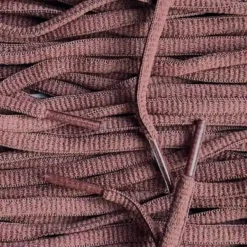
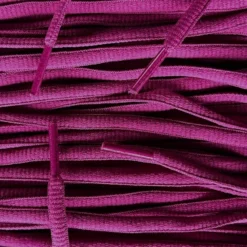
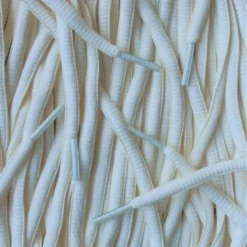
An oval lace is a cord with a flattened cross-section. It slides through the eyelet almost as smoothly as a round lace, but its flat sides hold the knot better. That combination works well in running and sports shoes. There you pull the lace tight and it has to stay that way while you move. That is why many running shoes come with oval laces as standard.
For most sports shoes, choose basic oval laces of 6 mm. If your shoe has larger eyelets or you want a fuller profile, thick oval laces of 9 mm are a better fit. You will find the full range under oval laces.
Which shape suits your shoe?
If in doubt, look at the lace currently in your shoe first. The manufacturer designed the eyelets around that shape. If you deliberately want something different, this table will help.
| Shoe type | Best shape | Why |
|---|---|---|
| Low-top sneakers and high-top sneakers | Flat, 8 mm | Lies flat on the instep and the bow stays tied |
| Skate shoes | Flat, 8 mm | Wide band with plenty of grip in the knot |
| Running shoes | Oval, 6 mm | Tightens smoothly and stays tight while running |
| Dress shoes | Round and waxed, 3 mm, or flat and thin, 4 mm | Fits small eyelets and looks refined |
| Work shoes and low boots | Round, 5 mm | Strong cord that slides well through eyelets and hooks |
| Kids shoes | Flat, 8 mm, or elastic | Easy to tie, or no tying at all |
Can you switch shapes?
You can, as long as the new lace fits through your eyelets. The test is simple: take out the old lace and push the aglet of the new lace through the smallest eyelet. If it goes through without forcing, it fits. A flat 8 mm lace folds over slightly in a round eyelet. That is normal and not a problem. Thick oval laces and chunky rope laces only fit through large eyelets.
Changing the shape also changes the look. A round cord looks slimmer and more formal. A flat band looks fuller and sportier. On a sneaker that came with flat laces, an oval lace gives a more technical look, while a round cord on the same shoe quickly looks too thin.
Does the shape affect lace length?
The shape makes little difference to the length you need. That mainly depends on the number of eyelet pairs and the way you lace your shoes. Count the eyelets on one side of your shoe and look up the matching length in our shoelace length guide. Veter.nl carries lengths from 60 to 180 cm. Only with thick laces, such as chunky rope laces, should you go one step longer when in doubt. A thick cord uses a little more length at every crossing.
Frequently asked questions
Which shape stays tied best?
Flat and oval laces hold a bow better than a smooth round cord. For the most grip, choose a waxed lace. The wax coating adds extra friction in the knot.
Which laces do sneakers come with?
Most sneakers come with flat laces about 8 mm wide. Sporty models and running shoes often have oval laces.
Are round laces stronger than flat laces?
A braided round cord is usually more hard-wearing than a woven flat band of the same material. That is why round laces are common in shoes that see heavy use, such as work shoes.
Do round laces fit shoes that came with flat laces?
Usually yes, because a round cord is narrower than a flat band. The lace fills the eyelet less and the shoe gets a slimmer look.
Know which shape you are after? Browse every version under laces by type and then choose your length and colour.