


Blogs
How to Teach Kids to Tie Shoelaces: 2 Easy Methods
Every morning the same question at the front door: can you tie my laces? Learning to tie shoelaces is a big step for many children, and knowing how to teach kids to tie shoelaces makes it a lot easier. With the right method, a lace that is easy to grip and a little patience, most kids get there within a few weeks. In this blog you will read when a child is ready, which two methods work best and which laces make learning easier.
In short
- Most children learn to tie their laces around the age of five or six. If your child can tie a simple knot and hold a loop, they are ready.
- The bunny ears method with two loops is the easiest for beginners. The classic one-loop method is quicker once it clicks.
- Flat laces are easier for small hands than smooth round laces, and the bow stays tied better.
- Two different lace colors make it easier to see which end goes where.
- If your child is still too young, elastic laces are a good stopgap.
When can you teach kids to tie shoelaces?
Usually around five or six, but skill matters more than age. A child is ready when they can tie a simple knot, hold a loop between thumb and finger and focus on something for a few minutes. Some children manage it at four, others not until seven. Both are perfectly normal.
Don’t start when you are in a hurry. Practise in the afternoon or at the weekend, a few minutes at a time. Ten short sessions work better than one session of half an hour.
Method 1: bunny ears with two loops
This is the easiest method to start with, because both hands do the same thing. Many children remember it thanks to the story of the two bunny ears.
- Tie the first knot: cross the two ends, tuck one underneath and pull tight.
- Make a loop with each end. These are the two bunny ears.
- Cross the ears over each other, the same way as the first knot.
- Tuck one ear under the other, through the hole that forms.
- Pull both ears out to the sides. The bow is tied.
Method 2: the classic one-loop bow
This method is quicker, but needs more coordination. It is a good one to move on to once bunny ears go well.
- Tie the first knot, as in method 1.
- Make a loop with one end and hold it.
- Wrap the other end around the loop.
- Push that end through the hole behind the loop, so a second loop forms.
- Hold both loops and pull them tight.
If the loops sit across the shoe after tightening, it is a strong bow. If they point along the length of the shoe, tie the first knot the other way round next time. Why that matters is explained in our blog about laces that keep coming undone.
Which laces make learning to tie easier?
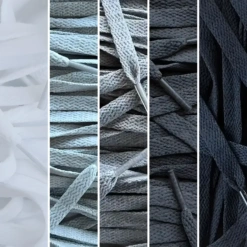
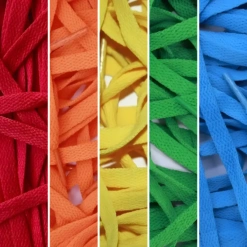
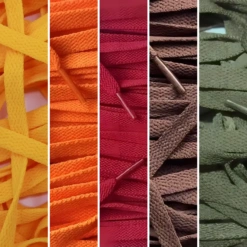
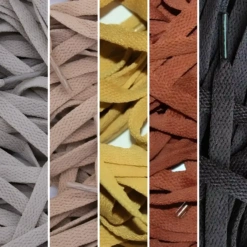
Flat laces are the best choice to practise with. They lie flat between the fingers, don’t roll away and the knot stays put while your child takes the next step. Smooth round laces slip out of the knot, which is frustrating for a beginner. Basic flat laces (8 mm) come in lengths from 60 cm, so they also fit small children’s shoes.
- 100 cm
- 120 cm
- 140 cm
- 160 cm
- 180 cm
- 100 cm
- 120 cm
- 140 cm
- 160 cm
- 180 cm
- 100 cm
- 120 cm
- 140 cm
- 160 cm
- 180 cm
- 100 cm
- 120 cm
- 140 cm
- 160 cm
- 180 cm
Practise with two colors
A handy trick is to lace a practice shoe with two different colors, for example one white and one red lace. Your child sees straight away which end goes over the other, and you can explain it simply: the red one goes around the white loop. Laces come in sets of two, so with two sets in different colors you have a practice pair and a spare pair.
Not too long
Laces that are too long make big loops and ends that drag on the ground. Children trip over them and the bow comes undone sooner. A rule of thumb for children’s shoes:
| Pairs of eyelets | Length |
|---|---|
| 3 | 60 cm |
| 4 | 80 cm |
| 5 | 100 cm |
Not sure? Count the eyelets on one side and check our shoelace length guide. All laces that suit small shoes are in laces for kids’ shoes.
What if it doesn’t work yet?
That’s fine. Don’t force it, or tying laces turns into a battle. Put it aside for a few weeks and try again. Children who couldn’t manage it at first often suddenly get it a month later.
Until then, no-tie laces are a good solution. You thread elastic laces once and after that your child slips in and out of the shoe on their own. How to fit them and cut them to length is explained in the guide how to fit elastic laces. As soon as your child wants to learn to tie, switch back to regular laces.
Read on: the best laces for kids’ shoes and how to tie shoes with one hand.
Frequently asked questions
Which method do children learn fastest?
Usually the bunny ears method with two loops, because both hands do the same thing. Once that goes well, you can move on to the classic one-loop bow.
My child is left-handed. Should I explain it differently?
Let your child hold the loop with whichever hand feels most comfortable. If you sit opposite each other, your child sees everything mirrored. Sit next to your child instead, so you both look at the shoe from the same side.
How do I stop my child’s laces from coming undone?
Check that the loops sit across the shoe. Use flat laces instead of smooth round ones and choose a length that fits. For sport or playing outside, a double knot adds extra security.
What length laces does a child’s shoe need?
Most children’s shoes need 60, 80 or 100 cm, depending on the number of eyelets. Count the holes on one side and use the table above.
Looking for new laces for small shoes? See all laces for kids’ shoes.